The Badge That Says Who You Are: Why Pins Still Matter for Pride

.jpg)
There is a small, deliberate moment most people never notice. Someone stands in front of a mirror before leaving the house, picks up a pin no bigger than a coin, and fastens it to a lapel, a tote bag, a lanyard. It takes two seconds. And in those two seconds, a decision has been made not about fashion, but about declaration. This is who I am. This is what I stand with.
For Pride Month, that small gesture carries the weight of a much longer history than most rainbow merchandise lets on. The enamel pin isn't a seasonal trinket. It belongs to one of the oldest and most stubborn human traditions there is: wearing a symbol on your body to say something words can't, to people you may never speak to.
A short history of saying it without speaking
Long before the enamel pin, there was the badge. Guilds used them to mark a trade. Pilgrims wore them to prove a journey. Political campaigns turned them into buttons by the millions, and a movement learned that a person's chest is the cheapest, most powerful billboard ever invented.
What unites all of them — the guild badge, the campaign button, the identity pin — is a single function. They let you announce belonging without making a speech. You walk into a room and the people who share your symbol already know. That recognition, quiet and instant, is the entire point. It's also why the pin became so important to a community that, for most of its history, could not always afford to say the words out loud.
From a mark of death to a mark of pride
No object tells this story more powerfully than the pink triangle.
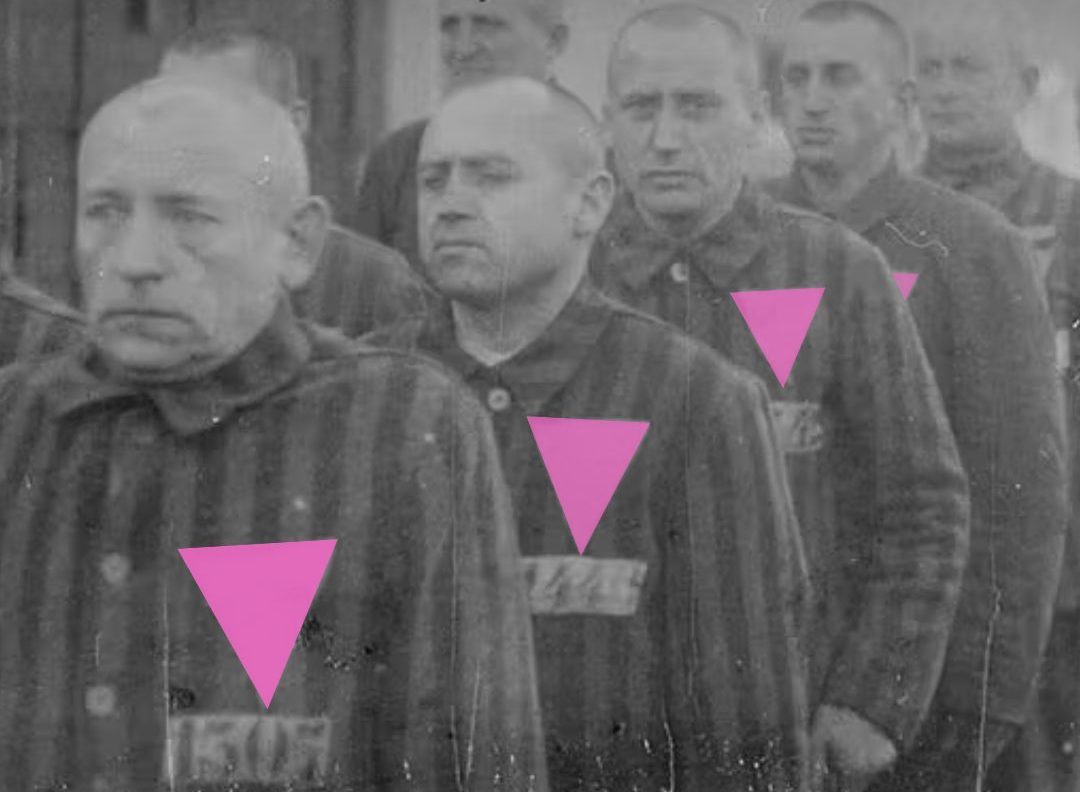
In Nazi Germany, the downward-pointing pink triangle was not chosen by the people who wore it. It was sewn onto the clothing of gay men in concentration camps to identify and dehumanize them, the same logic that forced the yellow star onto Jewish prisoners. Men marked with it were treated as the lowest of the camp hierarchy. It was, in every sense, a badge of shame imposed by murderers.
And then something extraordinary happened. In the early 1970s — as the gay liberation movement took shape and awareness of this history grew — activists did not bury the symbol. They reclaimed it. In 1973, one of post-war Germany's first gay rights organizations adopted the pink triangle deliberately, turning a mark of persecution into an emblem of resistance and memory. By 1977, American activists in Miami were pinning the triangle to their clothes in protest, and the symbol began appearing in the national press as a sign of solidarity.
It is one of the most complete acts of reclamation in modern history: taking the very thing designed to erase a people and wearing it, on purpose, as proof of survival. When that symbol appears on a pin today, it isn't decoration. It's testimony.
![Repost @lgbt_history ・・・ Prisoners wearing the pink triangle (marking them as queer), Sachsenhausen concentration camp, Sachsenhausen, Germany, Dec. 19, 1938. Photo c/o Corbis. [TW] . Between 1933 and 1945, the Nazi regime](https://cdn.prod.website-files.com/698122b05bc9eba0b48e5f77/6a1f5dc497b936a1d460b667_images.jpeg)
The flag, and the many symbols that followed
The pink triangle carried memory. The community also wanted a symbol that carried joy.
In 1978, urged on by Harvey Milk one of the first openly gay elected officials in the United States San Francisco artist Gilbert Baker designed a flag. He chose a rainbow on purpose: a symbol drawn from nature, broad enough to hold a whole diverse community under one sky. His original flag had eight colors, each with a meaning, from hot pink for sexuality to violet for spirit. Practical limits later trimmed it to the six-stripe flag the world knows now.
What followed was an explosion of visual language. As the community articulated itself more fully, new flags emerged for transgender, bisexual, and many other identities. And here the pin came into its own. A flag flies over a crowd; a pin sits on a single chest. It is small enough to be specific — to say not just I belong to this community but this is exactly who I am within it — and combinable, so a person can wear several at once. No other object lets identity be that precise and that portable.
What a pin means in June and the rest of the year
This is where the modern story gets honest.
Every June, rainbows appear on storefronts, logos, and corporate feeds, and a fair amount of it vanishes on July 1st. The community has a name for it: rainbow-washing — the gesture that costs nothing and means little. Pretending it doesn't happen would be the easy thing. But the distinction between performance and commitment is exactly what gives a physical badge its value.
A pin handed to an employee resource group isn't a campaign that ends with the month. It's something people keep, wear on a Tuesday in October, pass to a new colleague, leave on a desk as a quiet signal that this is a safe person to talk to. An ally who pins a flag to a work lanyard is making the same wager the activists of the 1970s made: that visible, everyday belonging changes the temperature of a room.
That's the difference between a symbol used and a symbol displayed. The communities, ERGs, institutions, and allies who treat Pride as a year-round practice tend to reach for the durable object — the thing that outlives the campaign — precisely because it signals that the commitment does too.
Honoring the history with good craft
If you are going to take part in a tradition this old a tradition that runs from the guild badge through the pink triangle to the lanyard pin worn by an ally — it's worth doing with an object that's actually built to last. A symbol that carries this much meaning deserves manufacturing that honors it: enamel that holds its color, an edge that doesn't wear, a design made with intention rather than pulled from a template.
That is the whole case for a well-made pin. It isn't that the object is precious in itself. It's that the object becomes the carrier of something that is — belonging, memory, pride — and a carrier should be worthy of its cargo.
When you're ready to create distinctive pins or patches for your Pride campaign, ERG, or organization, we're glad to help you make something worth keeping.
Quick answers
What does the pink triangle mean? Originally a Nazi badge forced onto gay men in concentration camps, the pink triangle was reclaimed by gay rights activists beginning in the early 1970s and turned into a symbol of liberation, memory, and pride.
Why are pins associated with Pride?Pins let a person declare identity and belonging visibly and permanently. They descend from a long tradition of badges and buttons used to signal who you are and what you stand with — a function that mattered deeply to a community long denied open visibility.
Who created the rainbow Pride flag?Artist Gilbert Baker designed the rainbow flag in 1978 at the urging of San Francisco official Harvey Milk. The original featured eight colored stripes, later reduced to the familiar six.
What's the difference between Pride merchandise and rainbow-washing?Rainbow-washing is surface-level symbolism that disappears after June. Durable, intentional items — kept and worn year-round by ERGs, allies, and institutions — signal genuine, ongoing commitment rather than a seasonal gesture.

.webp)
.webp)
.webp)
.webp)
.webp)
.webp)
-min.avif)
.webp)
.webp)
.webp)
.webp)
.webp)
.avif)