An Updated History of American Flag Lapel Pins



In the modern political landscape, an American flag pin on a jacket lapel is more than just an accessory—it is an expected norm. From presidential candidates to local community leaders, the "Stars and Stripes" pinned over the heart has become a universal shorthand for patriotism and public service. However, despite its current ubiquity, this custom is surprisingly young.
I. A Modern Symbol of an Ancient Tradition
While the design of the American flag was settled in 1777, the tradition of wearing it as a lapel pin didn't take hold until nearly two centuries later. Today, these pins are among our most frequently ordered items at PinProsPlus, particularly as citizens prepare for national observances like Memorial Day, Independence Day, September 11, and Veterans Day.
To truly appreciate the pin, one must understand that it isn't just a piece of metal—it is a storied symbol that evolved from military unit markers to a centerpiece of American fashion and political identity.
II. The Origins: From Battlefields to Private Homes
Despite what many believe, the custom of displaying an American flag lapel pin hasn’t been around as long as the flag itself. In the early days of the Republic, other than military units during the Revolutionary War, hardly anyone even owned a flag.
In the late 18th century, the final design of the flag was not settled until 1777—a full year after the nation declared its independence from Britain. Prior to that, a variety of designs flew across the colonies. For example, at the Battle of Bunker Hill, Americans fought under the "Flag of New England," which featured a blue background and a white field. Even the famous painting of George Washington crossing the Delaware includes a flag that technically wasn't designed at the time of the event!

According to Marc Leepson’s definitive book, Flag: An American Biography, the deep reverence Americans now feel for the national symbol was largely absent during the early years of the nation. It wasn’t until the Civil War that the flag truly became a symbol of individual patriotism.
As the Confederacy won early battles, Northerners began flying the flag in front of their homes and businesses as a sign of pride and support for the Union. While the end of the war saw a temporary decrease in flag-flying, the seed had been planted: the flag was no longer just for the military; it belonged to the people.
Here is the next section, detailing how the lapel pin transitioned from a rare collectible to a political staple.
III. From World War II to the White House: The Rise of the Lapel Pin
While the American flag became a household symbol during the Civil War, the lapel pin as we know it didn't make a significant appearance even during the height of World War II. According to Kim Hinrichs, one of America’s premier graphic designers and a collector of over 5,000 pieces of flag memorabilia, flag-related jewelry simply wasn't common for men or women until the 1950s.
Before the mid-20th century, one might find rare flag brooches or tuxedo buttons, but the standardized lapel pin remained elusive. So, how did it become the "uniform" of Washington D.C.?
The Nixon Influence
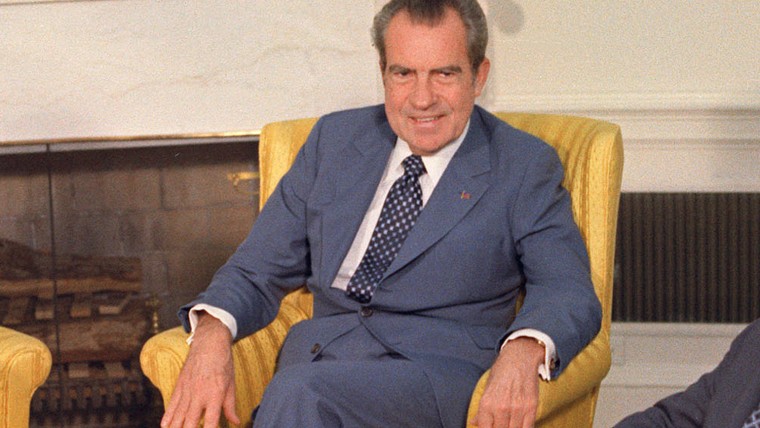
Richard Nixon was the first U.S. President to make the lapel flag pin a permanent fixture of his attire. The inspiration didn't come from military protocol, but from Hollywood. After noticing a character in the 1972 Robert Redford film The Candidate wearing a small flag on his suit, Nixon directed his entire White House staff to begin wearing one as well.
This move was not without its critics. During the Vietnam War, the pin became a flashpoint for political identity. While supporters wore it to signal "Silent Majority" patriotism, anti-war demonstrators sometimes wore the pin upside down—the traditional maritime signal for "dire distress"—to protest the conflict.
Despite these early controversies, the tradition stuck. By the late 20th century, the pin had transcended partisan lines to become a symbol of the office of the Presidency and the nation at large.
IV. Proper Etiquette: How to Wear an American Flag Pin
While wearing a flag pin is a powerful gesture of patriotism, there are established "rules" of etiquette to ensure the symbol is treated with the respect it deserves. Following the U.S. Flag Code and traditional sartorial standards ensures your presentation is both patriotic and professional.
1. The Left Side: Over the Heart
The most important rule of etiquette is placement. An American flag lapel pin should always be worn on the left lapel, near the heart. This positioning signifies that the wearer holds the nation’s values close to their core.
2. Proper Orientation
The flag should never be angled or placed haphazardly. It must be upright, with the union (the blue field of stars) at the top and to the observer’s left.
- Pro-Tip: If you are wearing a "Crossed Flags" pin (featuring the U.S. flag and another nation's flag), the American flag should always be on the left side from the observer's perspective, with its staff in front of the other flag's staff.
3. When to Wear Your Pin
While appropriate for daily business or formal wear, there are specific occasions when a flag pin is particularly significant:
- National Flag Week: Celebrated in June, this week commemorates the adoption of the Stars and Stripes.
- Federal Holidays: Memorial Day, Independence Day (July 4th), and Veterans Day are peak times for displaying the pin.
- Days of Remembrance: September 11 and Pearl Harbor Day (December 7) are solemn occasions where the pin serves as a tribute to those lost.
4. Respect the Symbol
The flag pin is considered a replica of the flag itself. Therefore, it should be kept clean, polished, and never worn on casual clothing where it might be easily damaged or soiled. When not in use, store your pin in a safe place rather than leaving it attached to a discarded jacket.
V. Choosing the Right Style for Your Custom Flag Pin
When ordering a custom American flag lapel pin, the "look and feel" matters as much as the symbol itself. At PinProsPlus, we offer several manufacturing styles, each providing a distinct aesthetic and durability. Understanding these options ensures your organization’s pins reflect the quality you intend.
Hard Enamel Pins (Cloisonné)
Often considered the "gold standard" of lapel pins, Hard Enamel pins are polished to a smooth, jewelry-like finish.
- The Look: Flat, shiny, and sophisticated.
- Best For: High-level corporate gifts, diplomatic missions, and long-term commemorative awards.
- Durability: Extremely scratch-resistant and designed to last a lifetime.
Soft Enamel Pins
This is our most popular style. Unlike hard enamel, the paint is baked into the "recesses" of the metal, leaving a raised metal border that you can feel.
- The Look: Classic, textured, and vibrant.
- Best For: Political campaigns, school fundraisers, and large-scale events like July 4th parades.
- Value: Offers a high-end look at a more budget-friendly price point.
Die Struck Pins
For a more subtle and elegant appearance, Die Struck pins forgo the colored paint entirely. These are struck from solid metal (like gold, silver, or bronze) to create a 3D relief.
- The Look: Sophisticated, metallic, and "old-school."
- Best For: Military honors or professional organizations that prefer a monochromatic, understated look.
Offset Printed Pins
If your design includes complex gradients, photographs, or a specific brand logo alongside the flag, Offset Printing is the solution.
- The Look: Exact replicas of digital images protected by a clear epoxy dome.
- Best For: Commemorative pins featuring specific historical photos or highly detailed state flags.
VI. Why PinProsPlus is Your Trusted Partner for Patriotic Pins
At PinProsPlus, we don’t just manufacture pins; we help you carry forward a piece of American history. For as long as we have been in business, our custom American flag pins have been among our top-requested items. Whether you are a travel operator ordering crossed-flag pins for an international journey or a local organization preparing for a Veterans Day parade, we understand the significance behind every order.
We believe that honoring the flag shouldn't be complicated or expensive. That is why we offer a seamless, high-value experience for every client. When you order with us, you aren't just getting a pin—you are getting our full suite of professional services at no extra cost.
The PinProsPlus Advantage:
- FREE Professional Design Help: Not sure how your logo will look next to the flag? Our experts will help you visualize it.
- FREE Artwork & Proofs: We ensure the design is perfect before we ever hit the production floor.
- FREE Unlimited Adjustments: We don't stop until you are 100% satisfied with the digital proof.
- FREE Ground Shipping: We provide free UPS ground shipping anywhere in the United States.
- Fast Turnaround: From our initial quote to your doorstep, we prioritize speed without sacrificing quality.
Ready to Order Your Custom Pins?
Ordering a custom American flag pin is simple, fast, and affordable—with prices starting as low as 60 cents per pin depending on size and quantity.
Get started today:
- Request a Free Quote Online (We respond within an hour!)
- Call us at (801) 544-1005 for an immediate consultation.
Whether it is for a national holiday, a corporate event, or a personal tribute, let us help you wear your pride with a pin that is as enduring as the flag itself.
Search
Recent Post
.jpg)
.jpg)

.webp)
.webp)
.webp)
.webp)
.webp)
.webp)
-min.avif)
.webp)
.webp)
.webp)
.webp)
.webp)
.avif)